Wednesday, 29 April 2015

Welcome to the Bureau of Media and Communications

Hello, everyone! 


I’ve been fielding a question from a few people about my work, and I realised that I haven’t really told anyone what it is I’m doing here in Bougainville in any depth. So I decided to write a post about my office and the projects we’re currently working on. Sorry if this is boring to anyone who is completely uninterested in archives, but hey, at least my Mum will appreciate it.

The ABG Archives, where I work, is a part of the Bureau of Media and Communication (Media and Comms), which is an Autonomous Bougainville Government (ABG) bureau. Our office is 100m from the airport (which is little more than a shed) in a complex of low-lying buildings. Media and Comms has a focus on print, radio and web communication, as well as being the centre for the ABG Archives and the Bougainville Arts Federation, which is relatively new project that Annabel, another VSA volunteer, has been working on. Media and Comms produces the Bougainville Bulletin, an ABG newspaper published every two months and distributed throughout Bougainville by some particularly dedicated staff who take it in to even the most remote communities. We also run Radio Ples Lain, a mobile (as in moving, not cellular) radio station which is dedicated to bringing ABG news to all of Bougainville by broadcasting in the field. The Radio Ples Lain truck is able to broadcast its programmes up to 50km away, depending on the geography of the area, thereby communicating information to communities which do not receive radio or mobile coverage. The Radio Ples Lain staff also work with NBC (the PNG National Broadcasting Corporation) to provide Bougainville-based content for the NBC station. Media and Comms is also currently building the ABG website and Tanya, our incredibly talented website and audio-visual staff member, is responsible for sharing media online.
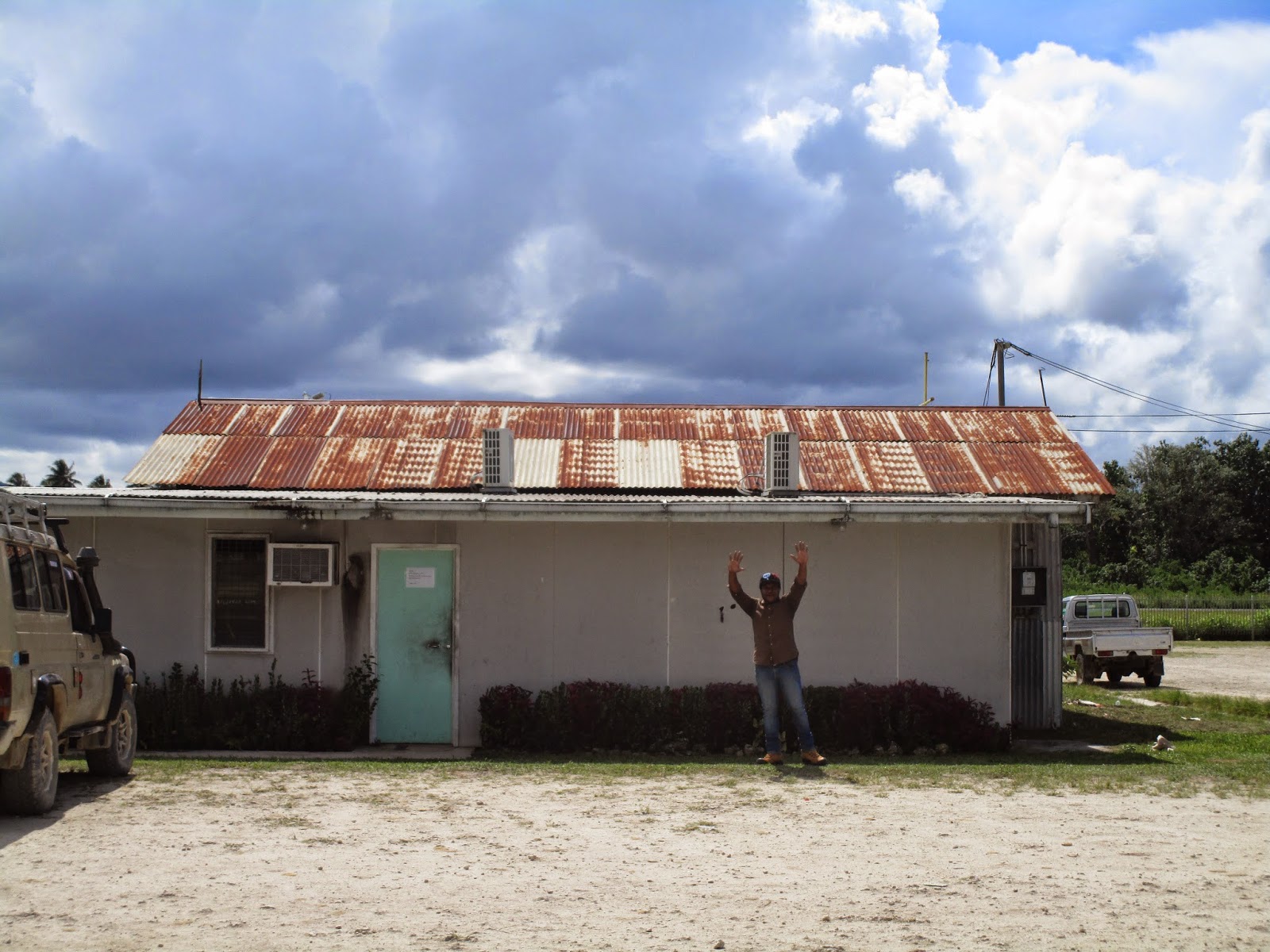
Ben, Radio Ples Lain presenter, outside the Media and Comms office.
 The ABG Archives office is a 4x8 metre room to the rear of the Media and Comms office, which houses three walls of floor-to-ceiling shelving for archived files and three desks (one of which is piled one metre high with extra files). My counterpart, Michael, and I work here. The purpose of the ABG Archives programme is to collect, manage and archive records created and received by the ABG, and to provide access to records and archives for ABG staff. My role as Records Management and Archives Assistant is to support Michael in his role as Archives Officer, to assist with the digitisation project and the promotion of the ABG divisional file classification, and to train ABG staff in records management procedures. The ABG Archives contains around 4000 records, mainly from 1990 – 2005, and includes highly important records from throughout the Bougainville Peace Process which are of significant cultural and historical value to Bougainville. In a somewhat sub-standard shed next to the Media and Comms office, thousands more old files await processing by Archives. The capacity to do so is extremely low, given that we lack the storage space and (wo)man power to efficiently process records. We are also slowly embarking upon a digitisation project. Again, until the ABG Archives Policy is approved by the government, we lack the finances and resources to scan archives efficiently and effectively.

In addition to our role in Archives, Michael and I are working with another person in our office, Moses, to coordinate some audience research commissioned by our office and carried out by the University of Goroka’s Centre for Social and Creative Media. The research will look in to the information and communication landscape in Bougainville including current knowledge, attitudes, misconceptions, risk perceptions and beliefs regarding the Bougainville Peace Agreement (BPA) and referendum among key audience groups. Our role is limited to organising field researchers and assisting with logistical preparations, but it is pretty fantastic to be able to assist with such an important project. Perhaps as much as 90% of Bougainvilleans have access to mobile coverage, but access to more traditional new sources such as radio and newspapers is incredibly limited in rural areas. The communication landscape is fascinating in this respect; social media in PNG is booming, but the online presence of government bodies and other major organisations is limited. In this sense, as far as I have observed, there is a huge gap between the primary communication method of Bougainvilleans, and that of the government. However, this gap is closing quickly due to projects like the ABG website and social media presence.

Priscilla, the Media and Comms Corporate Services Assistant, and me.

While it sounds like I have a lot on my plate according to the above job descriptions, my day-to-day work life is somewhat more sedate. I wake up around 7:45am, have a cold shower, breakfast and coffee. I generally try to leave for work around 8:30am, with varying success. It takes me just five minutes to walk to work – with my laptop in my backpack and my umbrella arming me against the rain or the sun, I turn left out of my driveway and walk along the roadside, parallel to the airstrip. As I walk past the tyre workshop and the trade shops halfway down the road, I respond to a chorus of “Moning!” from the men who work there. As I arrive at the Media and Comms office I have a chat with my friend Priscilla, the administrator, for a while, as well as other workmates. Michael and I usually chat while working, and lately he’s been speaking to me only in Tok Pisin so I have to learn. Work is slow, as everything is done on Bougainville time which means two-hour long meetings are the norm, and everything is discussed at length. Lunch is at 12:00pm, and I often go in to town to do a vege shop at the market, or else I go home for the hour to eat there. We clock off at 4pm, although often the power will go out some time around 2:30pm and so I go home early and work from home.

Me and Michael sitting in the ABG Archives Office.

In sum, my job is fascinating, frustrating, difficult and enjoyable. I am really only just getting the hang of things after two months here, and have accepted that it will take a long time for anything to happen. In fact, 10 months in Bougainville seems like barely enough time to really do anything! The core aim of VSA is ‘capacity building’, which means that when I leave here, Michael will hopefully have gained skills and knowledge as Archives Officer and therefore the capacity of the ABG Archives Office will increase. It feels a bit daunting to be faced with this challenge – as a young Development Studies and Maori Resource Management graduate with no experience in records management, I feel somewhat under-qualified to fulfill those expectations. However, I do have basic skills to contribute; computer literacy, time management, research skills, development knowledge and organisational skills. I remind myself that I am not a white savior flown in to ‘do’ development ‘on’ Bougainville; rather, I am here as a student. As I learn and build relationships, I will hopefully also bring something different to the table that may be useful. It is all about relationships, humility and reciprocity; this is Bougainville, after all.

Friday, 10 April 2015

Mipela bin go long Pok Pok


Over Easter weekend, Bryn and I travelled down to Arawa and then out to Pok Pok Island with some other VSA volunteers called Ann and Richard. It was such a wonderful weekend, and full of the relaxation and distance from Buka that I needed to refresh me at the end of my first month in Bougainville.

On the Thursday morning before Easter weekend, we took a boat across the Buka Passage to Kokapau and hopped in a PMV (Personal Motor Vehicle, a bus-cum-taxi-cum-death trap, used as the main mode of transport in Bougainville. Most PMV’s you catch in Buka are Toyota vans, whereas the PMVs that transport people to other parts of the islands are either Land Cruisers or flatbed trucks). The driver assumed Bryn and I were married and so graciously offered us the front seat to share; while we assured him we weren’t married, we weren’t going to give up the prime air-conditioned spot in the Land Cruiser. Having strapped our bags to the roof, we pulled out of Kokapau with Bryn sitting by the window, me wedged in between him and our friendly, buai-chewing driver, and eight other people piled into the back of the Land Cruiser. Speeding along the road, we bounced over potholes and were serenaded by an extremely loud soundtrack which included Rihanna, Eminem, Nirvana and the ever-present-in-Bougainville PNG/R’n’B mixes. 

The road from Buka to Arawa is largely unpaved, except for the odd newly-constructed bridge which provides 30 seconds of relief from the constant jolting of racing at 80km/h over a gravel road. Either side of the road, impenetrable bush makes way for the occasional coconut plantation. Young boys walk along the roadside swinging bush knives (not as weapons; bush knives are necessary to travel through the thick bush, and to open coconuts) and young women walk swinging children or bunches of firewood. Liklik markets scatter themselves along the road, selling buai, kumu, banana, kulau (betenut, green vegetables, banana, young coconut). We sped past all this, a daze of dust and blue skies and lush canopies and white smiles in dark faces. Suddenly, over a particularly rough part of the road in Tinputz, the driver bought the car to shuddering halt on the side of the road. Flat tyre. We waited while some of the men in the truck changed the tyre, and off we went again. Despite the increasingly hard road, a lack of sleep the night before had me nodding off. I awoke an hour later and the truck was stationary. I asked Bryn what was happening; flat tyre #2. In fact, the very spare we had just changed was completely deflated. This time, being down a spare meant that we had to wait on the roadside for another PMV to come by to lend us their spare. While we waited, I got out of the truck and had a look around. We were in Central Bougainville; the mountains rose to my right and at their feet coconuts palms bowed, laden with a climbing vine that is prolific and destructive here. A small track off the road led to a village from which two fat, beautiful roosters crowed and wood smoke rose to mingle with a mist rolling off the mountains. One could break down in a worse location. 40 minutes later we were off again, and soon we were driving in to Arawa.

Arawa is a world apart from Buka. Buka is dry, dusty and busy. In Buka the sun scorches and the wet heat seeps into every pore. There is no fresh waters source apart from rain, and the shops are crowded together in a bustling centre. Arawa is a few degrees cooler and any thirst quenched by the many rivers that run down the mountainsides. Wide streets lined with rain trees outline large, flat, green spaces. The exceedingly well-planned town betrays its old identity; a beautiful, manicured, spacious and prosperous mining town and centre of government. Now, the burnt-out shell of the old government headquarters and overgrown, disconnected power poles lining the road remain standing and derelict, a testament to the tragedy and destruction seen in Arawa during the Crisis. The old Arawa Carpentry warehouse, steelworks factory and Arawa Motor Company site are marked solely by the steel skeletons of structures which have been burned, looted and are now collapsed. Despite the scars of the Crisis, Arawa is slowly being transformed. A large marketplace bustles and overflows with the riches harvested from mountain soils. Small trade shops are dotted around the town and houses are slowly being rebuilt and lived in. The people are friendly, and despite unsafe drinking water and an unreliable power supply, there is an air of hope and possibility in Arawa. 

Arawa

Ann and Richard are both working and living in Arawa. Ann works at the Arawa Haus Sik as a physiotherapist and Richard is working with Bougainville Earthworks as an engineer. They are a fantastic couple, and are full of stories about Bougainville before the Crisis; while they had three young boys in the 1980s, they spent five years living in Arawa while Richard worked for the North Solomons Provincial Government (Bougainville had an independence movement in the 1970s that was temporarily appeased by PNG making it its own province; something that was rather token, given that the rest of PNG was split in to provinces as well). 

On Friday morning Bryn, Ann, Richard and I headed down the coast to Kieta to meet Joe, an old friend of Ann and Richards from Pok Pok Island who was looking after us for the weekend. The coast around Central Bougainville is stunning; as we rounded the corner and climbed the hill before Kieta, a blue expense of water glittered in the sun, framed by banana leaves and the white sand of the coast. WWII relics scatter the shores of Kieta port, alongside the small market on the beachfront of Kieta. Here we met Joe’s nephew Martin, who lives in the village we stayed in and was to drive us in his boat there.

Pok Pok Island is quite large, perhaps with a few thousand inhabitants in various coastal villages, and lies only one kilometre from the mainland. On the way to Martin’s village, Uruna, we stopped off at another larger village to top up on petrol for the boat. While waiting I began to play with some of the kids on the beach and joined them for a swim. They were gorgeous! I’ve always been a sucker for kids, and Bougainvillean kids have won my heart. Very few of them have the luxury of TV or toys. Instead, they spend their days outside in the water and sun. This builds a resilience and independence, and most Bougainvillean kids I’ve gotten to know are incredibly well-balanced. They are happy to make their own fun and learn at the same time. These kids on the beach were floating around on a few blocks of polystyrene packing material, and one kid was causing havoc by wearing a yellow, chicken tea cosy on his head which everyone else was trying to steal off him. As we were playing around in the water, I stepped on something that sent a sharp pain in to the ball of my foot. Unsure about what it was, I walked ashore and in the shallows, squeezed the spine of a small sea urchin out of my foot. At this point a small crowd of wet children surrounded me. Several wounds where more spines had lodged themselves were bleeding, and it was incredibly sore. Promptly, a small girl named Bernadine picked a rock up off the beach and began pounding at the wounds with it. Martin explained to me that they do this to break the spine to pieces inside the wound and when rinsed, the pieces come out. While I am dubious of the science behind this theory, eventually my foot didn’t hurt as much and within a few days it was completely healed.

Kids on Pok Pok Island. Bernadine is the girl in the middle with the blue shorts on.

After our stop at the big village, we continued on to Uruna. We were staying in a saksak (sago palm) and wood house, which was beautiful and simple. Flanked either side by the village, the house was right on the beachfront, where white sand meets crystal clear waters, under which colourful fish and giant clams on the coral reef can be seen. When snorkelling, the colours of these giant clams amazed me; mustard yellow flesh with huge feeding tubes gave way to maroon and violet lips, spotted with turquoise dots to attract smaller fish. These creatures are awe-inspiring, growing over half a metre wide. Around the giant clams, small electric blue fish, angel fish, fish of all colours feed and swim. The ocean truly is another whole world to explore. 

On Saturday morning, Ann, Bryn and I awoke at dawn and went out fishing with Joe. In the early morning sunrise, the reef looked like an aqua-blue gem, shimmering with activity. We sped out past the outer reef and in to the open sea. Thousands of small, luminescent blue specks sped underneath the boat as we motored along, creating an underwater Milky Way. A pod of feeding dolphins passed us by and hornbills and white cockatoos soared over the treetops of the mainland. Mount Bagana, the only active volcano in Bougainville, shimmered behind the morning clouds and spewed smoke in to the sky which mingled with the white mist. We spotted some bird feeding further out, and it was then that I began to understand the term “chasing the tuna”.

We sped over to the boiling patch of water where seagulls were diving at feeding fish and dropped out hand lines into the water behind us. No sooner had we begun trawling, Ann landed a yellowfin tuna at least three feet long which Joe hauled in barehanded. We raced around chasing tuna for the rest of the morning. We didn’t catch any more yellowfins, but I landed a small tuna and a rainbow runner, and Bryn also landed a nice fat rainbow runner. As we fished, flying fish skimming over the surface of the ocean and we spotted a marlin jumping out the water a short way from our boat. The ocean stretched for miles to the north east, and was spotted with gorgeous, white-sand islands to the west. We stopped off at a tiny deserted island called Kurukiki and ate a breakfast of fresh pawpaw, then headed home. We arrived back with our catch just as the sun began to beat fiercely off the water.

 The sunrise while fishing. The small reef marker that is only just visible in front the island in the photo was built by the Germans during WWI.
Joe, Ann, and Bryn with the yellowfin tuna.
We spent the weekend eating fresh fish, coconut and pawpaw until we couldn’t stand any more. We swam, napped on the beach, played cards, read our books, swam some more. I spent a wonderful afternoon on Saturday talking to two women from the village, Nancy and Justine, along with their kids. Justine taught me more pidgin and I managed to win the heart of her one-year-old daughter Ursula (although her grandson Casper remained terrified of all white people). We talked about their lives, arranged marriages, what New Zealand is like, where they were each from. Nancy is from Buka but had married a man from Uruna, and Justine is from Uruna. I was so sad to leave them behind; I feel like it’s quite hard to make good friends in Buka as everyone has their own families and friends, and it was so lovely to spend time with Nancy and Justine for just a few days.

After our few days in paradise, we headed home on Monday morning and Bryn and I spent the entire day travelling back to Buka (sans flat tyres, thankfully). We arrived home to refreshing rain and a birthday dinner for Paul (another VSA volunteer). On Tuesday had to return to work, and to reality. A reality which is still wonderful, but involves a lot more time in the office. C’est la vie!

Joe's well-worn fisherman's hands.

Sunday, 29 March 2015

I'm in paradise.

Avinoon tru! It’s been a crazy week, and I feel like my first month here is flying by. Now it’s Sunday evening and just as the sun sets, the power has turned back on. Thank you sweet Jesus for ceiling fans!

The past week at work has been pretty fantastic. My assignment with the ABG Archives Office essentially involves assisting the transition to a new database, enabling training and capacity building, and assisting with the continual processing of archival material. Michael and I have already identified a lot of goals that we’d like to achieve this year, so it looks like it will be a busy one. One of the projects I am involved in is the coordination of some research being done for the Bureau of Media and Communication by the Centre for Social and Cultural Media (University of Goroka, PNG). In true Bougainville style, the project didn’t happen for months and then all engines were go; the University of Goroka researchers flew in to Buka for a few days this week, so Michael and I spent a lot of time in meetings discussing research and workshopping with field researchers from around Bougainville. We’re still in the planning stages, but I feel very excited to be involved with ‘real-life’ research after years of writing essays within the four walls of Victoria University! Hopefully when the time comes to actually collect the data, I’ll have the opportunity to travel around Bougainville with some of the field researchers. It will be a great chance to see more of Bougainville, as well as to meet people, build up the research capacity in Bougainville, and hopefully, engage with and improve communication with some communities in more remote parts of the mainland. There is a small, eager Liv inside me that wants to go back to my development studies lectures and yell “I’M DOING FIELD RESEARCH!” at the top of my lungs.

After such a full on week at work I needed this weekend to treat me well, which it most definitely has. On Saturday afternoon, another VSA volunteer Moniek had her go pinis (farewell party) as her assignment is coming to an end this week. A whole group of friends and workmates hung out on the beach, played volleyball, and ate and drank a lot. It was a stunning day, much like any typical Kiwi barbecue except for the buckets of kulau (young drinking coconuts) and abundance of SP beer. To follow up a great afternoon with an even more amazing afternoon, today Moniek, her partner Paul, Bryn and I went to White Island with some of Moniek’s World Vision work friends and their families. White Island is a small island around 5 minutes boat ride from Buka town, and it is absolute paradise. Crystal waters fringe the white sands that lead to the leafy, shaded heart of the island. Only around 400 sq metres, White Island isn’t inhabited but is a popular picnic spot for people from Buka and the surrounding islands. Moniek’s friend’s Cecy and Vivienne had brought lunch with them, so the men built a fire and proceeded to cook up a huge pot of rice and around 30 chicken thighs for us all. I swam in the warm Pacific with Cecy’s daughters, walked around the island, got asked by two men visiting from the Sipik in PNG if I would take a photo with them, and achieved a gorgeous tshirt tanline. As the sun lowered in the west, the shadows of the palm trees lengthened and the day softened with golden light. After a few hours of bliss on what could have been the setting for Castaway, we arrived home just as the orange sun was setting behind the mango trees in Buka.

White Island.

Bryn and I.

Kids playing on a canoe.

Looking over Buka Passage, having arrive back to town.


Next week, over Easter weekend, Bryn and I are travelling down to Central Bougainville to stay on Pok Pok Island with another couple of VSA volunteers who work in Arawa. I’m really excited to get out of Buka and see more of Bougainville, and I’m also looking forward to a break from the business of town. I will be missing the annual making of hot cross buns and blown Easter eggs with my family, but, for me, Easter is a time to think of redemption and reconciliation and what better place to do so than in Bougainville, where these concepts are so central to the peace process?

I’ve loved my first month here. Buka becomes more familiar every day, and the fact that the people here are so friendly and quick to laugh makes it even easier. Being away from my family, Dan, and friends, is still hard, but less visceral. I feel very proud of myself. It may sounds strange to say, but I am in a place in my life where I have to have faith in myself and my ability to adapt, and I am proud that I am able to do that. I have many mountains to climb yet, but I think I’m going to be okay.


Tuesday, 24 March 2015

{moment}


The sky melts, from lilac to soft orange to the pink flesh of a pomelo. The vibrant ceiling of colours is pierced by the black silhouettes of the coconut tree swaying in the wind. The sounds of the night filter through the thick, sticky air; a child crying, the crackling of the fire, the pulsing of the ceiling fan. Slowly, dozens of small shadows appear on the horizon, bearing down through the last rays thrown out by the sun. Bats, with their wings spread wide to catch the slight breeze, make their evening exodus from the hills, from warm slumber to the night-time feed. They fly over me, graceful and weightless, through tangerine orange and in to the indigo of the evening.

Sunday, 15 March 2015

Poroman, Work and Wantok.

So I’ve been here almost two weeks, and while the bright sheen of new experiences hasn’t quite worn off, I’m settling in and slowing down.
Buka itself is a fascinatingly varied place. Coconut trees line the gorgeous passage which walls in one side of the market. Women sell their vegetables, coconuts, mangos, jewellery and bilum (bags). Right next to this picturesque island scene, a dusty road is lined with coke cans and bright red buai (betelnut) juice seeps in to the clay. It is hot. It is so hot that the five minute walk home from work warrants an afternoon nap; so hot that as I sit under the mango tree waiting for the bus, droplets of sweat roll down my neck and trail down my spine. Cold showers are a given, as there is no hot water at my house, but they are also a necessity.

One fool proof way to cool down is with a swim in the Buka Passage. On Sunday, a few other volunteers and I organised a boat ride to one of the islands not far from Buka. We planned on having a swim, lying around on the beach and having some lunch before returning home. However, the boat failed to show after a miscommunication about what time we wanted to head out so we instead went for a swim in the passage at an inlet not far from my house. There were about 30 kids all swimming there too, jumping off the rusted wreck of an old ship, diving and splashing. As soon as us white meri (women) and man (men) jumped in too, we were incredibly entertaining and elicited many laughs. I’m not sure what the kids found so funny about us, but the journey from being self-conscious to just accepting that you’re always going to be hilarious to the locals can be quite humbling. The water was clear and calm, and the turquoise rocks below shimmered as I dived in. I gathered some poroman (friends) as I swam, three girls that would not let go of me while I was in the water. Luisa, Mary-Jane and Aliente were all young schoolgirls that live in Buka, and we had a hilariously broken conversation in English and Tok Pisin. Luisa reminded me of myself, talking about how much she wants to go to a gudpela skol (good school) when she grows up, and maybe she could go to university like me! I definitely tried to encourage those dreams. Education is so empowering, and here in Bougainville the youngest generation is benefiting from an education system that has only been re-established in the past 15 years. They are the future of Bougainville.

Kids jumping off the back of the boat that ferries vehicles across Buka Passage.

I started work last Monday too. My office (the Division of Media and Communications) has around 20 staff in it, all of whom are incredibly friendly. At the moment I'm working with my counterpart, Michael, to get to know the Archives office and how it works. He is a lovely guy and incredibly willing to teach me all about Bougainville history and culture. We're also possible going to get in to some research this year, which could be exciting. Due to the regular power shortages here, I've had many an opportunity to escape my desk and sit outside under the mango tree to chat to the other women I work with. Many women here marry quite young, have completed their university studies in Port Moresby while raising children, and now work full time while being wife and mother. They are pretty incredible women!

It seems that it is much easier for women to do such things in Bougainville due to the Wantok system, which in a way is similar to the role of hapū in Māori culture. When women are working, their sisters, or in-laws, or aunties, will help raise children. Many family households are made up of various parts of the extended family and several people will be responsible for looking after the children are various times. Wantok literally means ‘one talk’, and refers to the people who speak the same language as you, or an extended family. The concept of homelessness is strange to people in Buka because if you are in need of money, food, or shelter, your family will always provide for you. In this way, the government does not have a welfare system because the intricate web of Wantok means that people will not rely on welfare to survive. Of course, there are holes and the system is not perfect. Nor is it able to fit perfectly in to an increasingly capitalist and urban society where families move away from their village and become more isolated. But in Bougainville, the system is still very much intact given the low levels of urbanisation and the geography of the islands.

Looking out to the eastern mouth of Buka Passage from Ieta Village.

So, after a wee while here, I feel like I’m slowly getting to know Buka. My body has relaxed into the slow rhythm of Bougainvillean time, succumbing to the heat and the lethargy. I miss home, Daniel, my family, a lot. But I am taking it one day at a time. While I feel like my sense of self has been put through a complete overhaul, I am coming to love this place and its people. I know the novelty will soon fade and it will become more difficult, but seriously – bring it on. What an experience! 

Thursday, 5 March 2015

I'm here!

The journey to Buka was long and tiring. I flew to Brisbane on Tuesday at 7am, met up with my fellow volunteer, Bryn, and we continued to Port Moresby (POM) to stay the night. POM is beautiful but difficult to get around safely so we were confined to the hotel. The hotel had a great pool though, so we took advantage of one more night of luxury before hitting Buka.

After a somewhat emotional night where I had a slight freak out ("What am I doing? Surely I must be crazy?!"), Bryn and I took a shuttle to the POM domestic terminal on Wednesday morning, which was a thoroughly overwhelming experience. A grainy speaker gushed forth constant announcements in Tok Pisin and English, none of which were decipherable given the constant static. People lined up and milled around with kids and bags everywhere. It took an hour to check in, but we eventually got on to the tiny plane and after a stopover in Rabaul, East New Britain Island, we arrived in Buka.

Flying in to Buka from the East.

Buka is so stunning. Any worries about my vocational choices were put at ease as we cruised over breathtakingly beautiful beaches, coconut plantations, mountains covered in thick bush and the turquoise Buka Passage. We landed on the shortest runway in the world, screeching to a halt outside a tiny tin shed where all the bags were dropped. Chaos ensued as people rummaged for their baggage, and Bougainville Security officials checked their bag receipts to make sure nothing was being stolen. Bryn and I were met by Raewyn and Chris, the VSA staff in Bougainville, and another VSA volunteer, Annabel, who works in my office. I quickly developed a sheen of sweat covering my entire body; Buka has a reputation for being the hottest part of Bougainville! The temperature hovers between 28C and 32C with around 90 per cent humidity. There is, however, a nice ocean breeze that provides some relief, and for the last 24 hours it has been raining, which means it is nice and cool, with geckos chirping around the house and crickets (I think) maintaining a deafening chorus.

My home for the year - Bryn lives downstairs, and I live upstairs.
The view from my balcony.
I have been into the Division of Media and Communications office to meet my workmates and boss, but I start proper work on Monday. For the last couple of days Raewyn and Chris (Chis is from Buka originally) have been taking Bryn and me around town, checking out the supermarket and the outdoor veggie markets, the trade stores and (my favourite part so far) the second-hand clothing shops! At the market the women all laughed at me when I asked how to cook a suspiciously prickly vine/green leafy vegetable. Everyone seems so nice and despite me being a white meri (woman) who seems to make a fool of herself all the time, the locals are incredibly welcoming and friendly. One thing I have learned is that if people say a meeting is at 9am, no one will actually turn up until 10:30am. Island time indeed!

Last night the VSA volunteers had dinner with the New Zealand Police Community Taskforce who are based here in Buka, as well as in Bruin and Arawa. On Saturday, a few of the other volunteers and I may organise a boat trip to one of the outer islands, and on Sunday we’re having a pot luck lunch at Annabel’s house. So, despite my occasional homesickness, I feel positive about making connections with people and getting to see more of Buka – and hopefully, down the track, more of Bougainville! Looking at the full moon as we ate dinner next to the passage, I was reminded that it was the same moon as in New Zealand.

I’m missing everyone at home terribly, but there are so many exciting new places to explore here, and people to get to know. I know it’s going to be hard in these first few months, but I’m also hopeful about the relationships I will build and the experiences I will have.

Sunday, 1 March 2015

Haere rā, friends.

I have the most wonderful friends.

The last week has been an overwhelming haze of goodbyes and packing. After spending last weekend in Auckland for the gorgeous Charlottes hen's, I flew back to Wellington on Monday, packed all my stuff up and shifted in with Dan for the week. I had a gorgeous dinner at El Matador with my wonderful flatmates followed by goodbye drinks at Southern Cross Garden Bar on Thursday night. Then on Saturday, Dan and I went for a beautiful walk along the south coast of Wellington, followed by Ekim Burgers and a beer. Sunday morning was full of tearful farewells as Dan saw me off at the airport for my Wellington to Auckland flight, and then last night we had a barbecue at Mum and Dad's house.

I fly out tomorrow morning at 7:00am, and after a stopover in Brisbane and a night in Port Moresby, I will be in Buka at 1:00pm on 4 March. I'm flying from Brisbane with another VSA volunteer called Bryn, so it will be cool to not be the only rookie on the block. I have no idea what to expect and so I'm keeping an open mind and an open heart...que serã, serã. Thank you to all those wonderful people who make it so difficult for me to leave! Because of your love I am able to go to Bougainville, confident that I have a support network ready to lift me up when I fall and cheer me on to the next adventure. I am so grateful for you! 


I'm also grateful for a beautiful evening with the bride-to-be.


For my two favourite people who get along wonderfully.


For Mollie, who is going to change the world.


For Vic, who has a contagious laugh.


For wonderful flatmates. 


For weird flatmates.


For the beautiful Whanganui-A-Tara.


For the person who makes me laugh more than anyone.


And for my family, whom I will miss immensely.